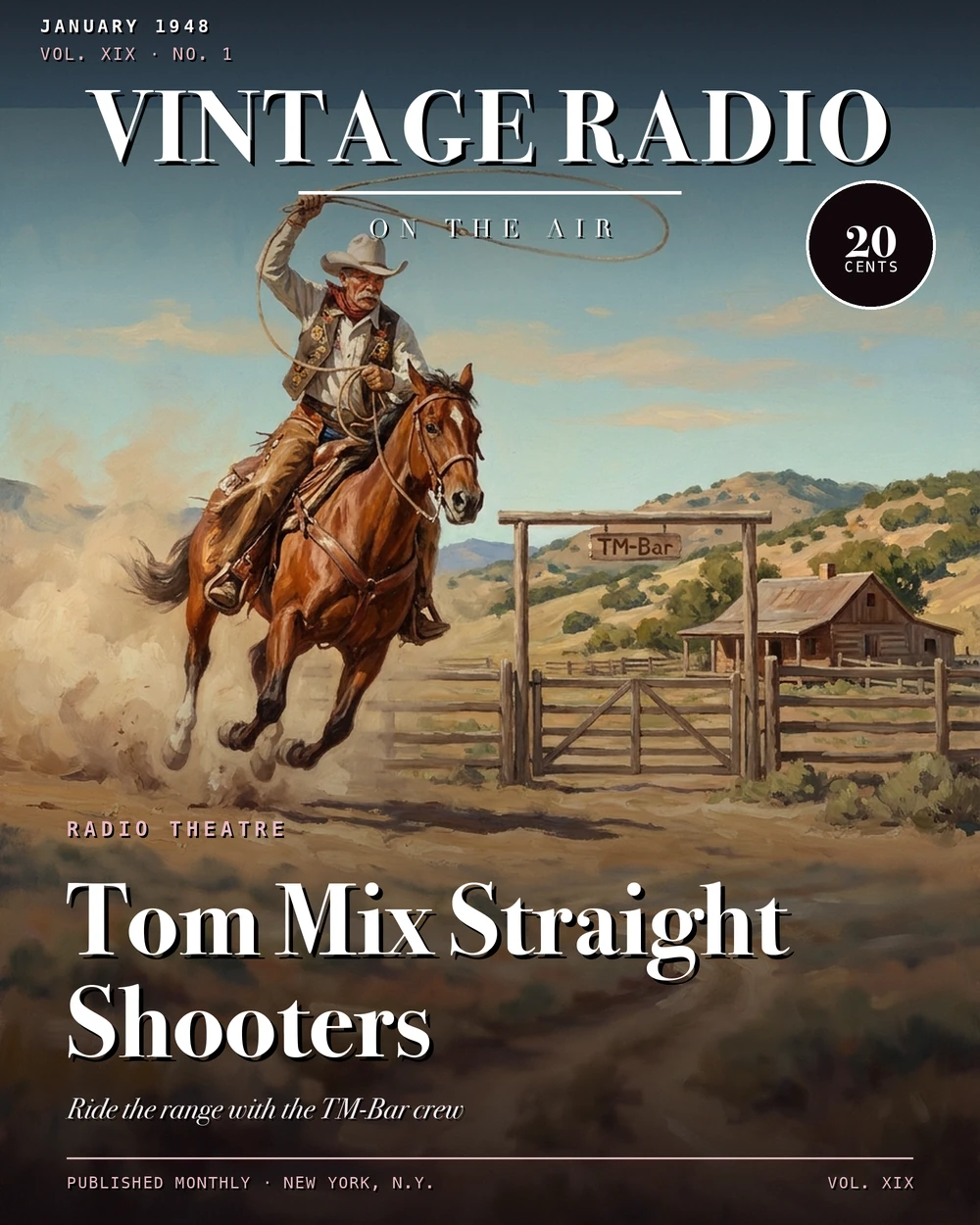
Tom Mix Straight Shooters
How It Got on the Air
The Tom Mix Straight Shooters came about because a young advertising man named Charles Claggett — then working for the Gardner Advertising Company in St. Louis — decided in early 1933 that Ralston Purina needed a radio show, and that Tom Mix was the right name to put on it. Getting Mix to agree was its own story. A Gardner official caught Mix at a circus stop and had him sign the licensing agreement on the back of an envelope. With that, Ralston had the rights to Mix's name and image, and Claggett set about building a format around them. A full-page Ralston newspaper ad featuring Mix had already generated responses from more than 250,000 children, so the appetite was clearly there.
The show debuted September 25, 1933, on NBC, originating out of New York City with actor Artells Dickson in the title role and Percy Hemus as the Old Wrangler. Roland Martini wrote the inaugural scripts. Within two seasons the production moved from New York to Chicago, partly so it only needed to air once for the national network — and Jack Holden took over as the voice of Mix. Russell Thorson followed Holden around 1938 and held the role for roughly four years before moving on to play Jack in I Love a Mystery. The show stayed on NBC through March 1937, then shifted to the Blue Network in September of that year.
The real Tom Mix had no involvement in the radio serial beyond lending his name and reputation. His voice was reportedly considered unfit for radio — a bullet wound to the throat and repeated broken noses from his action-filled career had done their work. The character on air was an idealized version of Mix anyway, partly constructed from the same mythology that Hollywood publicists had built around him for two decades.
The Man Behind the Myth
Tom Mix — full name Thomas Hezikiah Mix — was born on January 6, 1880, in Mix Run, a small settlement in Cameron County, Pennsylvania, about 42 miles north of State College. The legend that grew up around him claimed he had ridden with the Rough Riders, seen action in the Philippine Insurrection, the Boer War, and the Boxer Rebellion, and served as one of the last true lawmen in Oklahoma before heading to Hollywood. Later biographies found that his actual military record was undistinguished — no battlefield action, and a desertion in 1902. The Rough Riders story seems to have grown out of a real event: Mix rode in Theodore Roosevelt's 1905 inaugural parade with a group of fifty horsemen led by Seth Bullock, which publicists later spun into something more. What was real: he became a champion roper and rodeo hand, winning a national championship in 1909.
Mix entered the movies in 1910, making close to a hundred shorts for the Selig Polyscope Company before it folded in 1917, and then hit genuine stardom at Fox. His Fox salary eventually reached $17,500 per week during the silent-film peak of the 1920s. He lost heavily in the 1929 stock market crash but rebuilt through circus and wild west show work, partnering with Sam Gill in 1934 to form the Tom Mix Wild West and Sam Gill Circus (Combined). His final film was The Miracle Rider in 1935, a fifteen-chapter serial for Mascot studios, which did well at the box office. He died on October 12, 1940, when his car ran off Arizona State Route 79 near Florence. A stone memorial near the site carries the inscription: "In memory of Tom Mix whose spirit left his body on this spot and whose characterization and portrayals in life served to better fix memories of the old West in the minds of living men." The nearby gully is named Tom Mix Wash.
His funeral was held at the Little Church of the Flowers in Glendale, California, on October 16, 1940, attended by thousands. He is buried at Forest Lawn Memorial Park Cemetery in Glendale. The radio show, by then seven years in, kept running.
The Way It Sounded
The show opened with thundering hoofbeats and the Old Wrangler crying out, "Let's git-a-goin'!" After an opening pitch for Ralston — delivered in the program's signature singing-commercial style — the Old Wrangler returned to recap events and greet the young audience directly: "Howdee, Straight Shooters! howdee!" The drama was set at Tom's TM-Bar ranch in Texas, near a town called Dobie, where Mix lived with two young wards named Jimmy and Jane and the Old Wrangler as his elderly sidekick. Tom arrived on air to an organ crescendo, his horse Tony neighing and pawing the air. The theme song was "When the Bloom Is on the Sage."
The Ralston singing commercial became one of the most recognizable sounds in children's radio. It opened: "Shre-ea-ded Ralston for your breakfast, / Start the day off shinin' bright," and went on to praise the cereal's flavor, nutrition, and bite-size readiness. During the wartime years, with Don Gordon as announcer, the commercials were particularly well remembered. A recurring character named Wash served as cook and general ranch hand — a role Jim Harmon, writing in The Great Radio Heroes, described as shaped by the same Amos 'n' Andy stereotype popular throughout 1930s radio: easily frightened but always fighting down his fear. After Percy Hemus died, Sheriff Mike Shaw replaced the Old Wrangler as Mix's principal sidekick. Two other regulars were Pecos Williams, a ranch buddy, and Amos Q. Snood, the miserly hotel owner in Dobie who took pink pills.
Tom's adversaries included rustlers, killers, ghosts, saboteurs, invisible men, and at one point a giant — who turned out, in the wartime storyline, to be a trick device used to disrupt the domestic front. The show's willingness to mix western adventure with outright mystery helped distinguish it from straightforward cowboy serials, and in some rating books it pushed past even Jack Armstrong. It was described in some quarters as "radio's biggest western-detective program."
The Voice Most Associated with Tom Mix
Joe "Curley" Bradley came to the show by a longer road than most. His real name was George Raymond Courtney. He was born on September 18, 1910, in Coalgate, Oklahoma, and spent his teens doing stunt work in Hollywood for Hoot Gibson, Buck Jones, and the real Tom Mix himself. Bradley later recalled that Mix was aloof and distant, while Buck Jones was large-hearted and generous. He gave up the stunt work for a reason he described plainly: "I enjoyed singing. I didn't enjoy getting busted into bits."
Bradley joined the Tom Mix program in 1935 as part of a trio billed as the Ranch Boys — Jack Ross, Ken "Shorty" Carson, and Bradley — who sang songs and played bit parts. His character was Pecos Williams, Tom's top ranch hand. When the show returned from its wartime hiatus in June 1944, Bradley took over as Tom Mix himself, a role he held through the final broadcast. He was the only tenor among the actors who played Mix, and became the voice most listeners identified with the character. Outside the show, he appeared in the 1939 Gene Autry film In Old Monterey and was later a regular on Don McNeill's Breakfast Club. A 1951 film, Curley Bradley: The Singing Marshal, was built around his radio persona. He died on June 3, 1985, in Long Beach, California, and is buried at Rose Hills Memorial Park in Whittier.
Among the supporting players, Harold Peary played Sheriff Mike Shaw during the Jack Holden era. When Peary left for The Great Gildersleeve, Willard Waterman — who had joined the Chicago NBC radio pool in early 1936 and sounded enough like Peary that the two regularly traded roles — stepped in. Peary and Waterman became lifelong friends through the show. Waterman later succeeded Peary as Throckmorton P. Gildersleeve in 1950. George Gobel, who later found fame as a television comedian, played the character Jimmy during the show's run.
The Premium Machine
Tom Mix was one of the most prolific premium-offering programs in American radio. Over the life of the show, Ralston sent out more than 150 distinct items to fans who mailed in boxtops — sometimes with a dime — to Ralston, Checkerboard Square, St. Louis, Missouri. The premiums ranged from decoders and compasses to watch-fobs, spinning charms, a movie make-up kit, magnifiers, arrowheads, comics, caps, bandanas, and identification bracelets. Specific named rings included the Look-Around Ring, which used a diagonally mounted mirror to see around corners; a Magnet Ring with a real magnet as the "stone"; a decoder ring from 1946 with five decoder buttons; and a slide-whistle musical ring from around 1949. There were also glow-in-the-dark spurs and a luminous compass-magnifying glass combination.
Club members received the Straight Shooters' Secret Manual, which included a secret handshake and a password: "Ral," answered with "Ston." A photo album premium, advertised as containing "highly confidential information every Straight Shooter should know," cost a dime plus one or two boxtops. Ralston also issued twelve issues of Tom Mix Comics — mail-only premiums published from roughly late 1941 through mid-1942, with the final three issues renamed Tom Mix Commandos Comics to match the wartime setting. The comics featured art by Fred Meagher with back-up work by Charles Biro, later known for Crime Does Not Pay. Separately, Fawcett Comics published sixty-one newsstand issues of Tom Mix Western from January 1948 through May 1953, with covers by artists including Everett Raymond Kinstler; those issues advertised radio premiums inside their pages. The comic was also published in Sweden, Germany, Canada, Australia, and Great Britain.
The premium system was part of what made Tom Mix a genuine rival to Jack Armstrong in the afterschool hours. Both shows spanned more than fifteen seasons and drew consistently strong ratings in what the trade called the "wheat-and-barley hour," the 5 to 6 p.m. window when children came home from school.
The Wartime Gap and What Came After
Ralston cancelled the show in mid-1943, but not because of ratings trouble. The reason was wartime daylight-saving time, in effect year-round as "War Time." The company worried children would stay outside playing rather than come inside to listen. Claggett later said of the decision: "They were wrong, of course, but by the time they realized their mistake, we'd lost our time slot and it took me a year to get it back." The show returned in June 1944 with writer George Lowther, who was simultaneously writing scripts for Superman and Dick Tracy from his New York City office. Mix joined Jack Armstrong, Captain Midnight, Terry Lee, Hop Harrigan, and Superman in storylines pitting their heroes against Nazis and saboteurs; in one arc, Tom flew to Europe on a secret VE-Day mission with enemy agents in pursuit.
The postwar and late-run years saw significant format adjustments. A second Mutual run in 1949–50 aired as a thirty-minute program three times a week and carried the alternate title The Curley Bradley Show, foregrounding Bradley's identity directly. A Sunday-night run from August through December 1950 was titled The Singing Marshal. A fourth Mutual run followed in 1951. The final broadcast aired December 16, 1951. Announcer Don Gordon reportedly closed it out with: "In the heart and imagination of the world, Tom Mix rides on, and lives on, forever."
Recordings from the show are scarce. Roughly thirty scattered episodes survive — no complete story arc from the serialized format has been preserved intact. A fragment of "The Vanishing Village" arc survives with episodes dated August 10 and 13, 1945, but the larger story those episodes belong to is gone. For a show that ran eighteen years and reached millions of children, the surviving audio record is thin — which is one reason the premium artifacts, the comic books, and the memories of those who grew up with the program have carried so much of its history.